
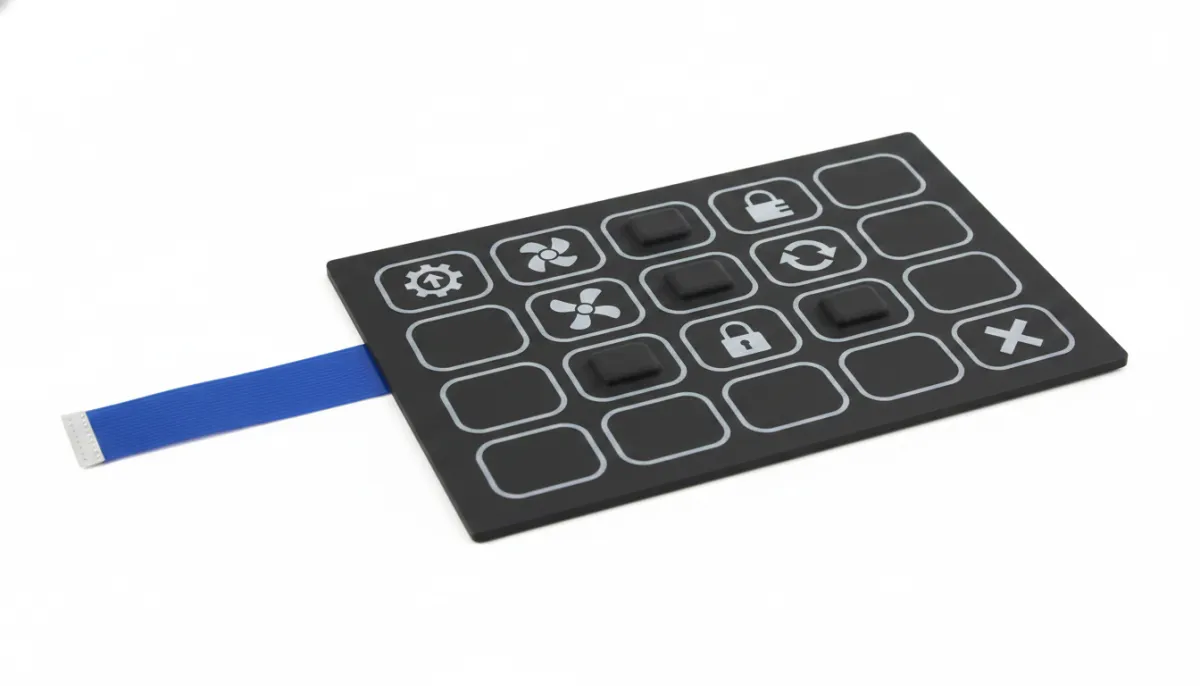
Discover how membrane switches enhance water quality monitoring systems with their customizability and durability.
Key Features of Membrane Switches
Membrane switches are widely utilized control mechanisms in industrial and electronic devices. These switches can be designed and customized for a variety of applications. In critical settings like water quality monitoring systems, the design of membrane switches plays a vital role. Here are some details on how membrane switches operate and where they are typically used:- Structure: Membrane switches typically consist of several layers. The top layer, known as Lexan Overlay, forms the surface that users interact with. Beneath this layer lies a circuit layer, and at the bottom, there is a support layer.
- Operating Principle: When a user presses a button, the top layer either opens or closes the underlying circuit, triggering a specific function. In water quality monitoring systems, these buttons are often used to display data such as pH levels and temperature.
Usage Scenarios
Membrane switches have a broad range of applications across various industries. Here are a few examples:- Water Quality Monitoring Systems: These systems utilize membrane switches to monitor the chemical composition of water. Users press the switches to view values like pH and temperature.
- Medical Devices: Membrane switches are frequently employed in hospital equipment. Their ability to operate in sterile environments makes them a preferred choice.
- Industrial Control Panels: In factory automation systems, it is common for operators to use membrane switches for machine control.
- Advantages:
- Durability: They are resistant to water, dust, and chemicals.
- Design Flexibility: Offers the possibility of aesthetic and functional design with customizable graphic overlays.
- Compact Design: Saves space and can be produced in various sizes.
- Disadvantages:
- Sensitivity: They can be sensitive to excessive pressure or impacts.
- Repair Difficulty: When they fail, they typically need to be replaced.
- How durable are membrane switches? Generally, they are resistant to water and chemicals; however, they can be damaged if exposed to extreme physical impacts.
- How is a custom design created? Custom graphic overlays can be created using specialized software and design tools.
- Do membrane switches require maintenance? They typically do not require maintenance, but it is advisable to clean them.