
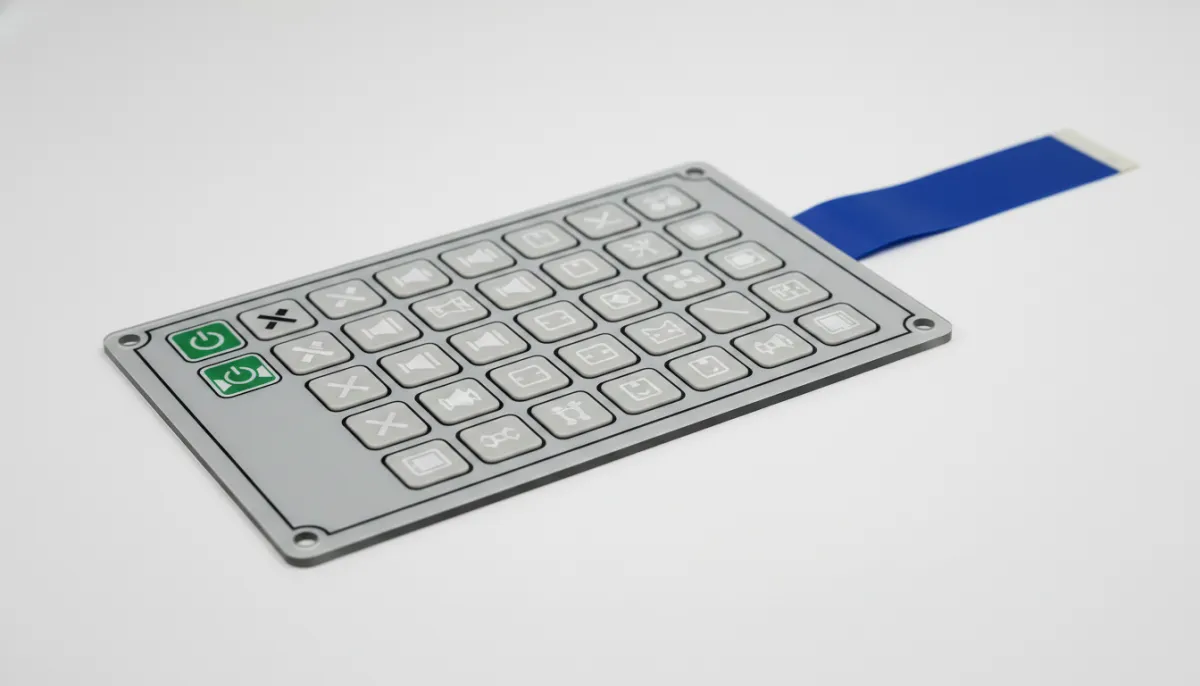
Discover the intricacies of membrane switch circuit design and its applications in electronics, industrial equipment, and more.
Membrane Switch Circuit Design
The design of membrane switch circuits is an essential element in today’s electronic devices. Membrane switches play a critical role in user interfaces, providing both functionality and aesthetic appeal. This article delves into the workings of membrane switch circuit design, their applications, as well as their benefits and drawbacks.
Technical OverviewMembrane switches typically consist of multiple thin layers. Within these layers, a circuit is formed that facilitates electrical connections. The design of membrane switch circuits includes the wiring of functional keys, which are pre-assembled during production, simplifying the assembly process.
- Pre-Configured Wiring: Membrane switches offer a system where the wires for each functional key are pre-arranged. This prevents connection errors and saves labor costs.
Membrane switch circuit design is generally executed using two primary methods:
- Common Line Method: In this approach, one end of all contact points is connected to a single line, while the other ends are directed through independent lines. This allows each contact to directly control a specific function. However, wiring can become complex when numerous contacts are involved.
- X-Y Matrix Layout Method: Contacts are arranged in rows and columns to form a matrix. Here, all contact points in one direction connect to a single line, while the opposite direction’s ends connect to a common line. A back-end analysis is necessary to control each specific function.
Application Scenarios
Membrane switches are utilized across various fields:
- Electronic Devices: Commonly found in user interfaces of remote controls, gaming consoles, and household appliances.
- Industrial Equipment: Preferred in automation systems and control panels due to their durability.
- Medical Devices: Widely used in medical instruments for their precision and cleanliness.
When considering the use of membrane switches, it’s important to weigh both advantages and disadvantages:
Benefits:- Cost-Effective: Manufacturing costs are usually low, making them advantageous for large-scale applications.
- Aesthetic Variety: They can be customized with different colors and designs.
- Durability: Their resistance to water and dust enables use in challenging environments.
- Low Mechanical Resilience: Mechanical wear can shorten the lifespan of membrane switches.
- False Activation: In situations requiring precision, false activation can be an issue.
- What materials are membrane switches made from? They are typically crafted from durable materials like polyester or polycarbonate.
- What is the lifespan of a membrane switch? It varies depending on usage conditions but generally lasts between 1 to 5 years.
- How should membrane switches be cleaned? Surface dirt and stains can be wiped away with mild soapy water.
Membrane switch circuit design holds significant importance in modern technology. With their ease of use, aesthetic design, and affordability, they are favored in many sectors. However, one must also consider disadvantages such as mechanical durability and the risk of false activation.