
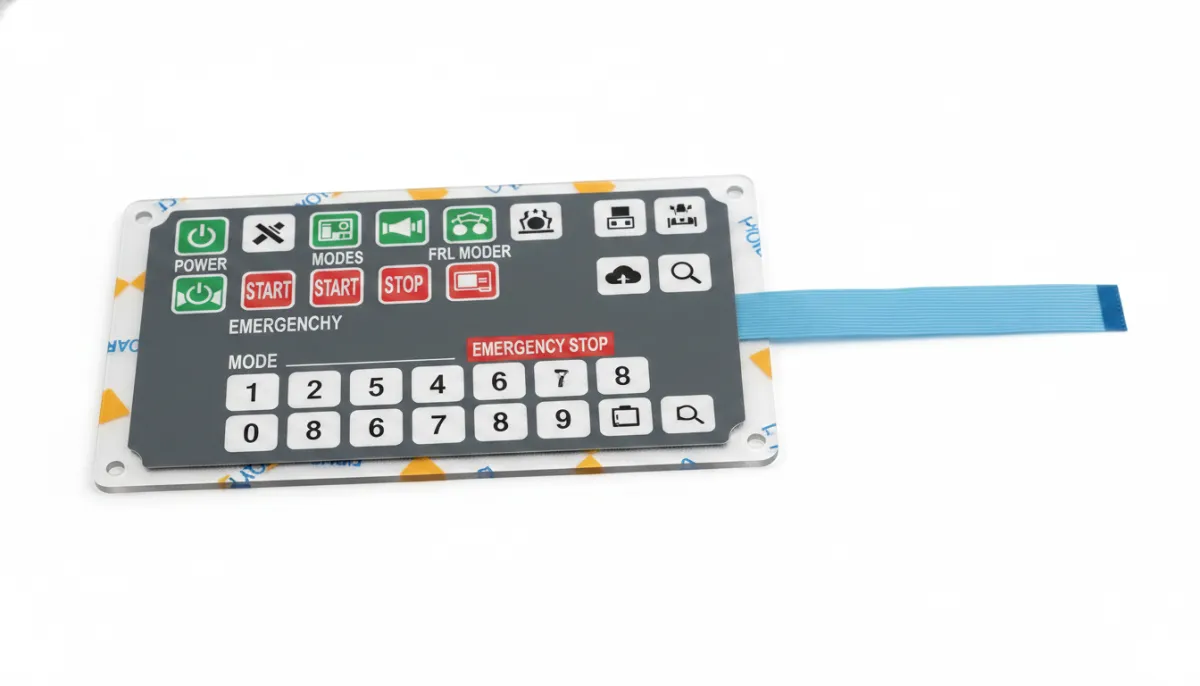
Discover the essential benefits of membrane switch panels for modern appliances, enhancing functionality and user experience in your home.
Key Features of Membrane Switch Panels
Membrane switch panels have become integral components in today’s household appliances, providing users with necessary interaction interfaces to control their devices. Typically, these panels comprise six distinct layers:
- Graphic Overlay: This is the visible surface that users interact with.
- Top Adhesive: This layer bonds the graphic overlay to the underlying layers.
- Top Circuit: The first layer responsible for transmitting electrical signals.
- Isolation Spacer: Creates a gap between the top and bottom circuits.
- Bottom Circuit: The circuit that enables the device to function.
- Back Adhesive: Facilitates easy mounting of the panel.
When a user presses a key on a membrane switch, it completes a circuit with the bottom layer, sending a signal crucial for the operation of various home appliances.
Applications in Household Appliances
Membrane switch panels are widely utilized across numerous household devices. Here are some application scenarios:
- Smart Electric Rice Cookers: Users can control the cooker by selecting cooking times and modes through the membrane switch.
- Washing Machines: These panels offer a straightforward interface for selecting different washing programs and temperature settings.
- Ovens: Users employ membrane switches to set cooking times and temperature adjustments.
- Water Heaters: Membrane switches provide a practical solution for controlling temperature settings and operational modes.
Moreover, membrane switches are highlighted by their low-profile design and lightweight construction, which aesthetically enhance the overall design of household appliances.
Benefits and DrawbacksHere are some advantages and disadvantages associated with the use of membrane switch panels:
- Advantages:
- Aesthetic Appeal: Their modern designs offer a sleek appearance.
- Durability: They are long-lasting and withstand various environmental conditions.
- Easy Cleaning: Their flat surfaces make them easy to clean.
- Moisture Resistance: They can be safely used in humid environments.
- Disadvantages:
- Repair Difficulty: In case of a malfunction, they can be challenging to repair.
- Accidental Pressing: Accidental button presses may lead to unintended outcomes.
- What is the lifespan of membrane switch panels?
Depending on the quality, they can typically last several years. - Are membrane switches waterproof?
Yes, they are designed for use in humid environments. - How do you maintain them?
Thanks to their flat surfaces, they can be easily cleaned with a damp cloth.
Membrane switches were first developed in the late 1970s. Since then, their popularity has surged in both electronic and industrial applications. Initially used in a limited range of devices, today they are found in a vast array of products, from household appliances to the automotive industry. With ongoing technological advancements, the functionality and aesthetics of membrane switches continue to improve.
In conclusion, membrane switch panels enhance the efficiency of home appliances and elevate the user experience. With their modern designs and functionality, they are poised to see increased usage in various sectors in the future.